Why Reciprocity Might be Bullshit
The gangster’s refrain, when there’s extortion a-foot: ‘I do for you, you don’t do for me…’. The gangster has lent us money, for which, at the time, we were very…

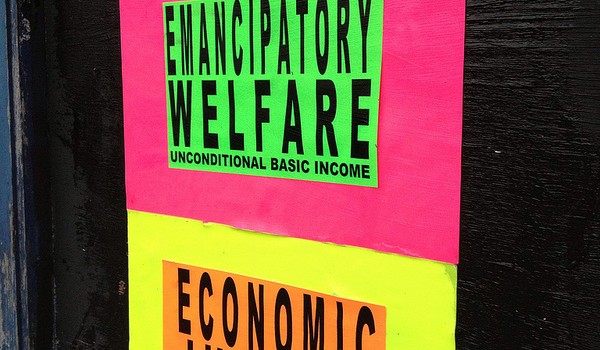
In this article Ben and Bert of Manchester Plan C discuss the potential dangers of the shared ground surrounding possible defences of a basic income. They argue that we should be careful to keep the more transformative potentials of basic income firmly in view.
The concept of a ‘universal basic income’ (UBI) – a regular stipend distributed to all members of a population – has recently emerged within certain left circles, including our own organisation, as a demand with potentially radical consequences. Yet the UBI proposal is not confined to the haunts of radical leftists; a recent New York Times article by the Princeton and LSE economist Paul Krugman called for a basic income to ‘solve’ the problem of technology-induced unemployment. A recent interview has suggested that there are in fact three ‘families’ of thought that argue for a UBI, ranging from communist through to liberal and republican positions, the latter having an almost Hayekian undertone of guaranteeing our ‘freedom from domination’. Does the UBI therefore provide a surprising point of agreement across the political spectrum, or do we need to go beyond a simplistic ‘for or against’ response and discuss our visions of the society behind it? This brief article will attempt to think through the potentials of non-progressive UBI policies and will argue that we need to be aware of the differing politics and potentials behind the policy of a UBI.
In a recent article, Thames Valley Plan C have suggested that ‘the UBI is a reform that, although not capable of displacing capitalism on its own, sets the stage for the further radical transformation of society’. As well as providing us with an assured basic standard of living and remunerating us for the largely unwaged reproductive work that capital relies upon, such as childcare and housework, it will also provide the material conditions for further experiments beyond the current constraints of society. Whilst we are therefore sympathetic to the possibilities this kind of UBI system could offer, we need to be aware that just as there are many different arguments for UBI, there are different ways it could be implemented. Given the disparity between the left’s current social power and that of neoliberalism, it is possible that we could witness the eventual implementation of a UBI as part of an austerity agenda, facilitating the offsetting of the crisis through the slashing of the social wage and further extending the marketization of society.
Consider the following scenario: Every citizen is handed their stipend which they are free to spend as they please. Whether we choose to spend it on healthcare, libraries, education, sports and recreational activities or trash-collection, our consumption of services becomes a matter of personal choice. Rather than the unequivocal socialized demand for healthcare, playgrounds and libraries that currently pertains, we instead expose these services to the vagaries of individualized consumption. Rather than a service that is provided free to all at the point of consumption, the viability of a service becomes measured according to people’s willingness to purchase it using their UBI.
The UBI is therefore potentially compatible with the extension of neoliberal reforms across the entirety of social services. It is not hard to imagine the total privatization of all social provisions in the name of ‘increasing quality through competition’. After all, if there is a demand for a ‘public’ library, people will use their stipend to pay for it, and the ‘success’ of the library becomes measured by its ability to attract UBI expenditure. Those services which offer ‘substandard’ services will thus fall by the way side, as more ‘competitive’ libraries manage to gain the dominant market share.
Try envisioning an ‘Even Newer’ Labour politician delivering the post-election speech:
“We believe in guaranteeing people the ability to protect and promote their own well-being as they see fit. Through introducing a monthly stipend, we will allow individuals to vote with their feet, supporting those services that offer ‘value for money’, and punishing those who fall short of expectations or lag behind the best in our society. This is about empowering people through their daily decisions, putting politics into the content of everyday life”.
This neoliberal vision of the UBI would be a world in which all decisions are economic decisions, one in which all services are dervied from a world framed by competition. Whether one decides to spend their stipend on a new Ikea table, a face-lift, their lithium prescription, schooling for their children or getting their bins collected is entirely up to them. The extent to which we believe in ‘universal healthcare’ or ‘education for all’ will be tested by our willingness to pay for it. What is deemed ‘right’ will not be a matter of public debate, but will in every instance be deferred to the market: A post-political ‘capitalist realism’ made real.
It remains an intriguing debate whether the demand for a UBI can form part of a broader package of more revolutionary reforms that simultaneously improve well-being whilst opening the space for non-capitalist alternatives and revolutionary projects. What becomes clear, however, is that the demand for UBI, when abstracted from the existing socio-economic context and isolated from wider political struggles, threatens as much to augment further neoliberal reforms as it offer prospects for the fomenting of revolutionary projects. We are thus less concerned with what UBI is than with what UBI does. Unequivocal support for the policy may lead us down paths that betray our political sensibilities, creating conditions antithetical to those commitments we regard as worthy of our efforts.
Through our organising we will encounter perspectives which differ, often drastically, from our own. There is nothing inherently progressive about UBI and we shouldn’t see everyone who is discussing it as a potential comrade. We need to be aware of the differing politics behind the same policy. We will share common points of agreement with many arguing for UBI but not with everyone. The challenge is to identify those perspectives which offer elements of a more liberated future and those which do not. A neoliberal version of UBI grounded in the promotion of a Hayekian version of liberty certainly does not echo with our politics, and we must challenge them or run the risk of “winning” something we don’t want.
Photo Courtesy of Russell Shaw Higgs




A fine article and I agree with the main thrust of the argument but I would be careful to lump the libertarian focus on negative liberty with the republican focus on non-domination. These two ideas have very different histories and it’s important to recognise the distinctions in order, as you rightly argue, to separate the perspectives we agree with from those with which we want no truck
Just trying to get up to speed on these debates and climb on board the train. Agree good article. I wonder though how much traction the libertarian arguments actually have. One can see the theoretical attractions of creating a passive, consumerist society where everyone, armed with their UBI, can procure the services they ‘want’, individuals functioning merely as a node for the flows of cash through the system. But the reality is that the present welfare system is an essential element, ideological and practical, in the exercise of class power and control. I see no sign of any serious move to abandon it.
Interesting point… I have colleagues who have the same ambivalence regarding the welfare state and see UBI precisely as the means to break free from that ‘essential element’… not abandoning it of course but placing it on a very different basis to its current forms and ways of functioning.