ReCivitas project at Oxford 1 Feb 2016
by George Bangham The ReCivitas project has paid an unconditional basic income to members of a small community in Quatinga Velho, in the state of São Paulo in southern Brazil,…

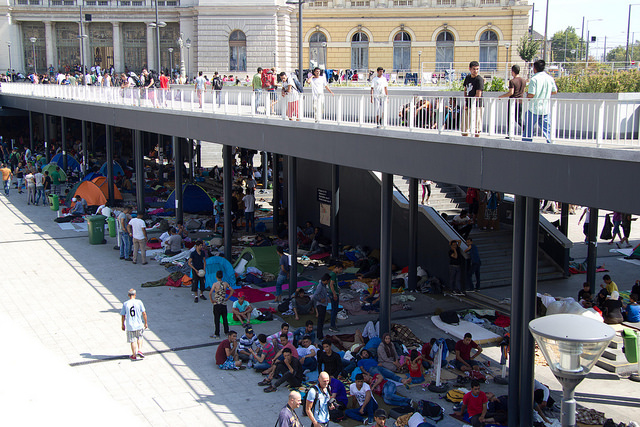
The ongoing migrant/refugee tragedy within and at Europe’s borders lays down a gauntlet to advocates for basic income: If the development of UBI within Europe depends on closing and (it’s always going to be) violently maintaining its borders, is UBI a policy that can take any kind of priority?
The reason for tension between immigration and UBI runs like this: The country or countries that introduces a substantial UBI quickly becomes the most generous provider of welfare. This will entice large numbers of migrants to the country, looking – quite rationally – for the best place to move. Even with the establishment of residency qualification, any time served in pursuit of belonging to such a generous system will be entirely worth it. There will be other considerations of course: presence of family, friends, compatriots; the native language spoken; the attitudes of the local population. But it is safe to say that the introduction of UBI adds one huge reason to the pile.
Bracket whatever arguments might be made w/r/t immigration’s effects on cultural collapse, the perishing of local values – which perhaps, once the rhetoric has been sufficiently diluted, have some merit but are too often way overstated and, to my mind, of less value/importance than open borders.* But anyway bracket that. The argument to focus on here is one of more technical-economic sustainability : Open borders will undermine the ability of the state to provide UBI to those entitled to it because of the increasing number of those recipients, i.e. those entitled to it. We have then, a race to the bottom where the notion of ‘minimally decent’ or ‘sufficient’ gets chipped away to inadequacy.+
Of course, the situation is more complex than this description grasps. Here we have a state on the one hand getting on with the business of social justice. And here we have a group of people looking for economic opportunity. This is a benign image of the state obfuscating important political realities. In particular, the hand Europe/The West has had in devastating the home countries of literally millions of people. Not only through colonialism, war and the support of genocidal dictators, but also through the kinds of economic liberalization that has been forced through in these countries (with the help of the gangsters put in charge, as well as the ideologues of IMF/WTO, etc). So the correct image is really of a gang of thieves, perhaps a gang that has had something of change in heart – they are delivering UBI after all – that has decided to mend its ways, but only so far – certainly not so far as to offer genuine salve to the historical/contemporary victims of its thieving.^ Whether we like it or not, we – and I mean that as broadly as possible – are involved with that gang – and have, in a great many ways, benefited from being, however begrudgingly, in/near/part of that gang.
To counter a possible counter-argument: That refugees and economic migrants are not the same. We can afford to open our borders to the former without opening our borders to the latter. First, the state is very good at using these kinds of distinction to its own benefit: I’d anticipate – with the evidence of historical precedence – the state shifting a great many applications into the economic half of that distinction. Second, I would also resist falling into this distinction in the first place: Not wanting to be murdered and not wanting to starve are imperatives that lie pretty close together on the spectrum of (intensely) valid reasons. Third, even with the acceptance of that distinction this still needs to be recognized as the curtailment of freedom that it explicitly represents.
I would argue then that unless UBI and open borders can be delivered simultaneously, then a decision has to be made about which should have more a more axiomatic role in both ‘our’ thinking about what to do and the decision as to what we end up doing. And with that decision the acceptance that the costs are going to be huge for some people. It will not do to point to various pilot schemes in the Majoritarian World that have proved the viability of UBI in such contexts – as things stand, those pilot schemes do not touch the sustainable material reality of people’s lives. Nor will it do to posit the notion that we can simultaneously enjoy UBI + violent enforcement of borders, alongside advocating for it in other parts of the world. This is simply a refusal to address the stark reality of the choice that is between UBI and exclusion on the one hand, or open borders on the other.
Of course, the salience of this rift between the two aspirations is especially acute as things stand. But there is no reason to believe these kinds of issues are going to resolve themselves in the short-term or mid-term. And so the question of priorities asserts itself: Do ‘we’ focus on delivering ’emancipatory welfare’ for the (to put it somewhat provocatively) the select few, which relatively speaking we really are? Or do we fight for the kind of open borders that are necessary both for the survival of a great many people and that match our affirmation of some of the most important freedoms?
Or is the calculation of an altogether different hue, one that takes seriously the quality/tragedy of political battles: Do we pick the battle that can be won?
…..
* NB: There is an argument for example that culturally more homogeneous countries are better able to sustain generous welfare states. However, I find this way of looking at things a little reductionist. For example, the UK – which overall has a population that is 87% white/ 80% British whites – has pockets of intense ethnic diversity sitting alongside almost total homogeneity. I would like to study that takes into account this dynamic. My intuition is that the culturally heterogeneous parts, so long as above a certain socio-economic threshold, are actually far more likely to embrace a generous welfare state than the culturally homogeneous areas.
+ There is another option not covered here: Allow individuals in and cut them off in substantial ways from the welfare system for long periods of time: this would be something like permanent guest-worker status, eradicating (large parts of) the incentive effect while still keeping borders open for those who are happy with that status.
^ For doubters, see Churchill’s proclamation to much the same tune: “We are not a young people with an innocent record and a scanty inheritance… We have engrossed to ourselves an altogether disproportionate share of the wealth and traffic of the world. We have got all we want in territory, and our claim to be left in the unmolested enjoyment of vast and splendid possessions, mainly acquired by violence, largely maintained by force, often seems less reasonable to others than to us.”
###
Main image: Courtesy of Eadaoin Flynn
Second image: Courtesy of Josh Zakary
Third image: Courtesy of Rasande Tyskar



This entire debate cannot be isolated from the issue of overpopulation. The world produces a finite amount of resources (i.e.food) that can only support a fixed number of people. Where technology might increase computing power or manufacturing oputput thousands of times more than our current level, food production is limited by the amount of light the sun delivers to the earth: Something completely out of our control.
Take a population density map of the world and overlay all the regions of famine, genocide etc. and an obvious correlation exists. Places with continued population growth are the root of the problem.
The current obsession with finance has obscured the obvious source of Chinese economic development: The one child policy. Thirty years of one child policy, thirty years of unprecedented economic prosperity. Japan and Germany, low birth rates for half a century, massive technological advances and economic growth. Meanwhile the populations of central Africa and South America continue to expand and continue to produce increasing poverty and conflict.
Welcoming immigrants with open arms sounds heart-warming but it ignores the fundamental question: Why are they leaving their home countries? It all boils down to overpopulation. Immigration just transfers the problem from one location to another. A large part of the reason for European affluence is centuries of low population growth.
There needs to be a plan based on the number of people a nation can sustain at acceptable levels of material comfort. Most people in the west don’t know the Chinese have a specific number – 680 Million – as their long term population goal. This is the number their scholars determined is the maximum that can be sustainably supported by farming all the arable land in China. Western nations need to learn this type of long term thinking, planning a century in advance, not just for the next election cycle.
Adult decisions need to be made. When the Titanic sank at first the survivors who made it into the lifeboats dragged as many people out of the water as they could save. Then when the lifeboats were overfull and in danger of sinking anyone who came along after that had to be rejected lest the whole boat sink. Nobody wants to be the one who says “No more”. Its an unpleasant job, but someone has to do it for the good of all. Too many white knights want to shoot the messenger and play the good guy without thinking about the consequences of their actions, consequences that may only be sufferred by their children or grandchildren.
Immigration numbers need to be decided (continuing the above metaphor) not by the number of people ‘in the water’ but by the capacity of the lifeboat. Only when the worlds population is in harmony with nature can borders be erased and only then can there be abundance for all.
Agree with the identification of a problem: overpopulation. Moreover, I embrace the idea of living within our (planetary) means – distinguishing that from the austerity argument – And, with that in mind, America and Europe are far bigger problems than anybody else! (Those ‘adult decisions’ then should refer to capitalism generally, not reproductive quotas)
But overall, this comment simplifies difficult problems into far too few variables with far too little recognition of the complexity of the variables at stake. The very nature of finitude/scarcity is a totally contingent term that things like technology and scientific advancement are constantly expanding – that does expand to food production as well: if it was just sunlight at stake we wouldn’t have come this far.
For instances of simplistic causal connection see: “places with continued population growth are the problem”: in what sense ‘the problem’? What are the causes of this overpopulation? For instance, one of the major remedies to overpopulation is the liberation of women – see Amartya Sen’s work on Kerala which compares favourably to China’s. So the problem actually offers solutions that don’t require coercive central-planning over reproductive rights, but more freedom.
In addition, you casually link a one-child policy to massive Chinese growth: spurious at best: what about a massive and cheap labour force, special economic zones, state support of industry, huge energy and mineral resources. Japan is currently going through enormous stagnation and Germany facing massive demographic pressures (indeed, one of the reasons it is willing to take in more migrants are for purely economic reasons: namely, the replenishment of a workforce).
Moreover, and more importantly, the current migration/refugee crisis is a direct consequence of imperialism (old and new) which again we’d do well to avoid laying causal blame at the foot of overpopulation. Indeed, there is a hefty body of literature that places European/American dominance squarely on the shoulders of mass super-exploitation, industrial dominance and an international regime geared in its favour through direct violence and (coercieve) economic apparatuses. To suggest its because we didn’t do much fucking is borderline obscene.
I disagree that overpopulation is such a key problem. The problems are I think as David has identified: exploitation, colonialism, the vast rip-off of vast swathes of the earth and humanity by a relatively few bandits for the last 400 years…
And where women have the money, independence, education and aspirations which a basic income would allow, the birth rate drops. It is the most effective contraceptive, far better than handing out condoms, doing ‘sex education’ (although both these help) or passing laws and the pain – and imbalance of population – which they cause.
of course it can only be for citizen’s and with qualifying prinicples of some kind. It would be extremely foolish to give it to anyone that just turns up.
bear in mind that ‘citizen’ is not a static term, i.e. unless you do something like say ‘these are the people who are to count as citizens’ and then end all processes by which citizenship can be gained, you’re going to have incentive effects – people coming to a place where UBI is on offer in preference to other places because there is a route to a UBI for those that stick it out. So anyone who turns up and sticks it out, gets UBI: That’s problematic.
The point of the article is somewhat different however: Open borders – if this is considered a progressive policy – will conflict with the closed borders required to effectively implement a UBI at a national, or even supranational level. I don’t think this can be fully justified in light of the violence involved in maintaining borders – especially when the violence that is being fled by refugees and migrants is as considerable as it is. The only justification becomes something like the following: Open borders are preferable but unlikely, UBI is less preferable but more likely. Therefore, we fight the second fight, even though it lacks the moral justification a policy of open borders enjoys.
What about a system that only pays basic income at a “home country” rate? You travel for a better paid job, but any UBI would be paid at a rate akin to what you would get in your home country; after a number of years your home country would change. I would remit the difference to your home country as a part payment to cover the costs of being raised and educated there.
I admit this in undeveloped but something I have thought about.
Sure – across Europe that might work, but the problem would then be the (bureaucratic) surveillance of people who would, perhaps, take a UK stipend and move to Portugal. Of course, maybe this isn’t a problem at all – esp. since movers would perhaps be few – though Lisbon a hard city to say no to. However, there is the general point that such a tactic improves the position of the wealthy vis-a-vis the poorer nations.
Also, does your suggestion include ref to ‘home countries’ outside Europe? So, Syrian refugees would have access to a BI similar to the average wage of their home states? This would be problematic for many reasons, so i don’t think it touches the deeper international problems that impact on this issue of borders… which was my main worry (and looking at the current collapse (both moral and institutional) of the EU, it just looks like a problem w/out an end in sight).